
Editors Note:
When I started the Belldumber I had no plan to ever grow it from more than just me. With the growth of my career has come the ability to grow this site and commission interesting and unique reporting. I’ve obtained the services of Mason Bindemann, an enthusiastic and incredibly bright Ohio State student with a knack for reporting and finding a story. He runs Generally Assembled, a great read about the absurdities of Ohio State student government.
Mason is being compensated for his work (a core value of mine) but if you like this story his Venmo is below and you should tip!
I’d love to keep having him, and perhaps more, new and different voices here and a free Belldumber subscription will help make that possible. Now, onto the good stuff!
Two weeks after Ohio State Assistant Professor Luke Perez assaulted a local documentarian outside a Chase Center event, the university’s investigation continues.
But there’s a fundamental problem: Ohio law gives Chase Center Director Lee Strang “sole and exclusive authority” over personnel decisions at the center, raising serious questions on whether Ohio State can actually enforce its own workplace violence policy without Strang’s approval.
Last Monday night, February 16th, as the Chase Center hosted a lecture on the costs of free speech, I asked Strang on the record about how this plays out.
When Perez threw documentarian Mike Newman to the ground on February 10, for attempting to ask Vice President E. Gordon Gee a question, Ohio State responded swiftly. Within 24 hours, Perez was placed on administrative leave pending what spokesman Ben Johnson called a “very concerning” investigation.
Seven days later, the Chase Center hosted Professor John Thrasher from Smith College to discuss dissent, civil discourse, and the price society pays for open inquiry.
With The Rooster unable to access future Chase Center programming for the foreseeable future, I figured I’d attend as a registered student.
The Gatekeepers of Free Inquiry
Attending Monday’s lecture required advance registration and check-in upon arrival. Even free inquiry needs a guest list, apparently. Columbus’s wine-and-cheese crowd showed up in full force.
Being a student helped me blend in and Director Lee Strang greeted all students beforehand, including me.
I reminded him we’d spoken over the summer and once I jogged his memory, Strang smiled and said he hoped I’d ask good questions. I assured him I would try.
Professor Thrasher’s talk explored the philosophical foundations of free speech, the cost societies bear to protect dissent, and the importance of maintaining civil discourse even when disagreements run deep.
The finer points of political philosophy might not be my forte but the Fisher College of Business has given me an even more valuable credential, unearned confidence.
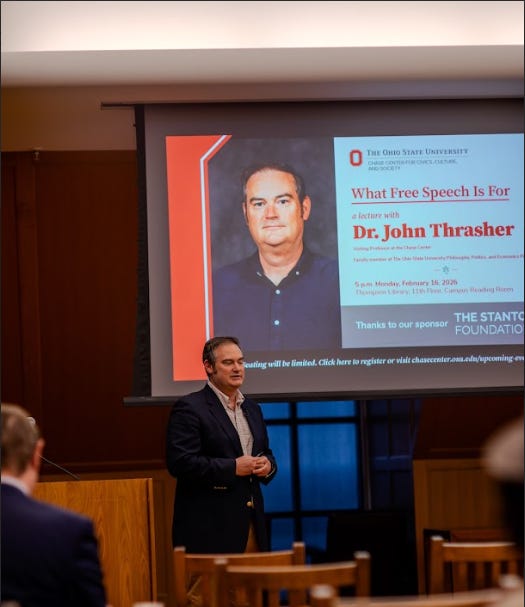
Putting Theory Into Practice
When the Q&A opened, I was the first to raise my hand. (For my troubles, I walked away with a copy of Thrasher’s page-turner, Introduction to Philosophy, Politics, and Economics.)
I asked Thrasher whether last week’s incident gave him any pause about joining the Chase Center next fall and whether he had any concerns about the center’s free speech norms in practice.
[Note: A link to the full question and answer audio is available: Here]
His answer was a masterclass in evasion. He immediately retreated to semantics, distinguishing between “norms and practice.” The Chase Center’s norms are fine, he assured me. Whether everything happens according to those norms? “That’s a different story altogether.”
When pressed, Thrasher insisted he wasn’t worried about the institution or the people. Sometimes things happen that you don’t expect or want, he conceded, but he wasn’t sure if that even applied here.
That might be more convincing if the center had been around longer than two years. When your entire institutional history could fit on a note card, one assault isn’t a statistical anomaly; it’s a notable portion of your track record.
The Real Question
After Thrasher’s talk, another student asked whether DEI initiatives could be seen as affirmative for free speech. The question was intriguing enough that I caught up with her afterward to ask what she thought about critics who’ve referred to the Chase Center as “conservative DEI.”
We were mid-conversation when Director Strang walked over to thank me for my question during the Q&A. I excused myself from the other student and turned my attention to Strang.
As an Ohio Revised Code enthusiast, there was something that had been eating at me about the statute establishing the Chase Center. Section 3335.39 grants the center’s director, Strang, “sole and exclusive authority” over all personnel decisions, including hiring and firing.
Ohio’s Republican legislature designed the Chase Center to be insulated from direct university oversight.
Even with Ohio State investigating Luke Perez for workplace violence, there’s a serious question about whether the university can actually do anything without Strang’s rubber stamp.
So I asked him directly: There’s a university investigation underway, but the statute gives you sole authority over personnel decisions at the Chase Center. Given that tension, what happens from here?
He deftly pivoted to process, saying the goal was to ensure they’re on the right path going forward and that the appropriate decision would be made based on what the investigation finds. He didn’t engage with the statutory question.
The Letter and the Spirit
It’s worth unpacking why that matters. Ohio State’s Workplace Violence Policy (7.05) clearly prohibits “threatening behavior and/or violent behavior that causes a disruption to the work environment.” Luke Perez, according to his personnel file, is subject to this policy.
But state law gives Strang final say. The statute doesn’t carve out exceptions for university investigations or HR policies.
In this case, I’d like to believe Strang will do the sensible thing and fire Perez; the assault was clearly caught on video. But it raises a question about what happens in the future when a fireable offense occurs but isn’t nearly as blatant.
The Chase Center has provided a fascinating case study on Thrasher’s central question: What costs are we willing to bear to protect free speech? As it turns out, those costs can include being wrestled to the ground by a professor.
This is the first real test case of what happens when university rules collide with the Chase Center’s statutory independence. Can Ohio State actually enforce its own workplace violence policy, or is it limited to strongly worded suggestions?
Perhaps this incident will prompt the state to reconsider its approach to fostering intellectual diversity in our public universities. But given the track record, I’m not exactly holding my breath.
We’ll see how long it takes Ohio State and Director Strang, separately or together, to do the right thing.
Thank you for reading! If you liked this article please consider sending Mason a tip and subscribing to The Belldumber for more.
